

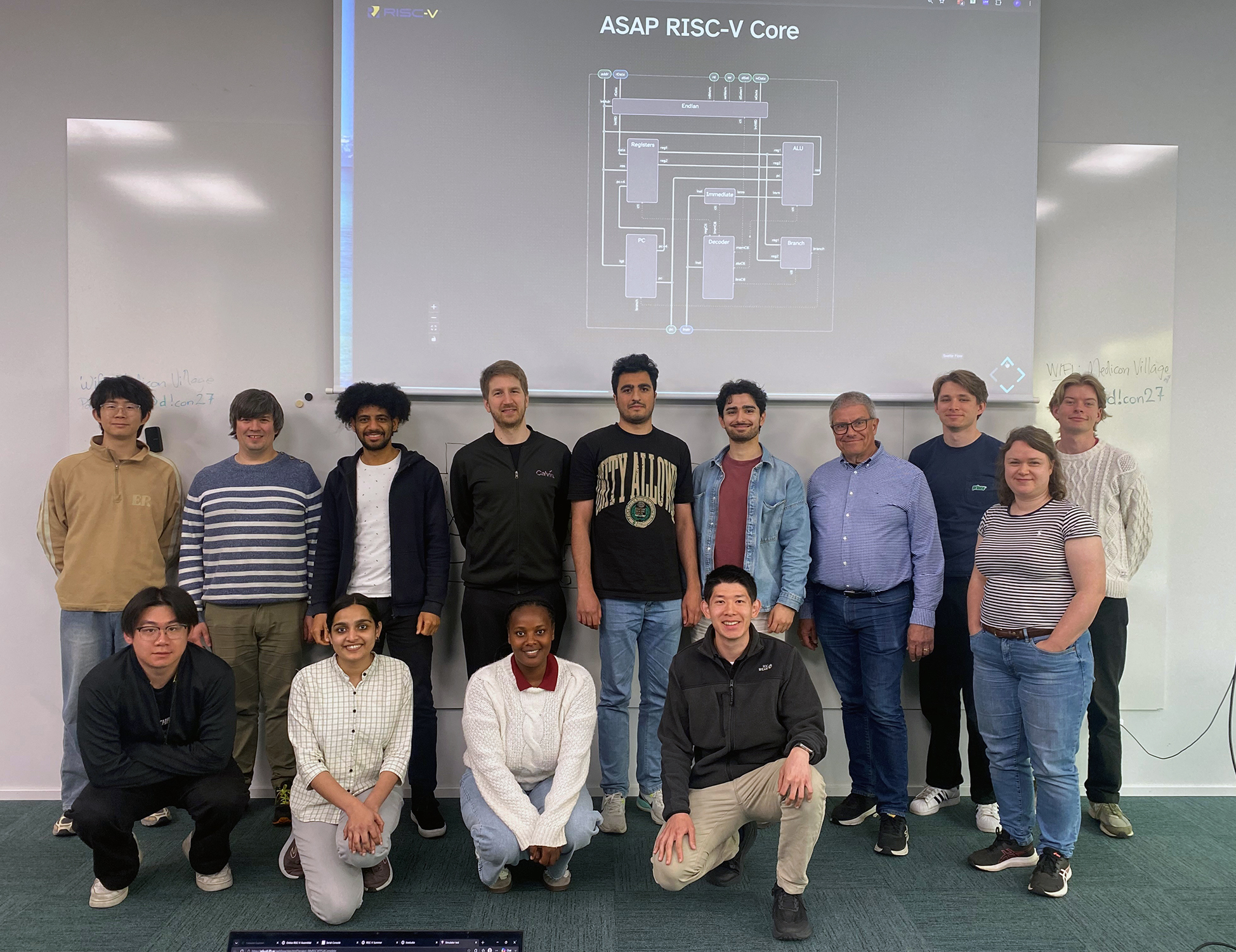
The 2026 edition of the SCCC Summer School on RISC-V on a chip in three days attracted a lot of applications from both students and employees at companies throughout Europe and beyond. A group of twenty participants were admitted and got to build their own physical RISC-V processors and run real hardware programs in just three days.
The summer school is directed to anyone interested in digital chip design, RISC-V and the power and simplicity of present generation open-source tools. The focus is on how digital systems, capable of executing real programs, can be integrated with ease and thereby inspire and encourage the next generation of engineers to exploit and implement such functionality in their future designs.
Here are some take-aways from the participants in the 2026 Summer School on RISC-V:
Catherine Njuguna, Kenya (Semiconductor Technologies Limited, STL)
“I learned about the summer school through my employer, Anthony Githinji, CEO and Managing Director of Semiconductor Technologies Limited (STL). Earlier this year, there was a semiconductor investor forum where some of the participants were from Lund University and SCCC. This sparked my interest and motivated me to learn more about the university. Around the same time, I also came across a LinkedIn post about the summer school.
The company I work for is looking to develop a semiconductor training program. STL is the only company of its kind in Kenya and one of the few in Africa. The continent currently lacks sufficient semiconductor expertise, and such training would be instrumental in building a strong African semiconductor ecosystem. Through the summer school, we hope to gain knowledge that can be shared with others and contribute to developing local talent.
Back home, I am also a student, and I can incorporate the knowledge gained from the summer school into my studies. Having learned the fundamentals of RISC-V and simple digital designs, I can apply these concepts to my research and studies in memory design.”
Marcin Kowalczyk, Poland, AGH University of Krakow
“I have learned the basics of RISC-V, which will be useful in both my research projects and my teaching. I teach FPGA-based image processing, so many of the topics covered during the summer school are related to my work. It was interesting to see how these solutions are used in real products and applications.
I found out about the summer school online. First, I came across information about the 2025 edition, and then I saw that it would also be organized in 2026. As far as I know, it was the only RISC-V summer school in Europe.
I have really enjoyed my time here in Lund, especially the visit to AXIS Labs. Their work is very close to my own research area, so it was particularly interesting for me.”
Key takeaways from the course
The course organiser, Per Andersson Ph D and Senior Advisor at Lund University, summarises the course for participants with various backgrounds and experiences:
“We provide an overview of modern digital chip design, insight into the RISC-V architecture, as well as insight into the incredible, combined power and simplicity of open-source tools applied to a non-trivial design. Although the designs could, in principle, be fabricated as standard CMOS chips, we use Field-Programmable devices to avoid a multi-month wait and a huge cost.”